
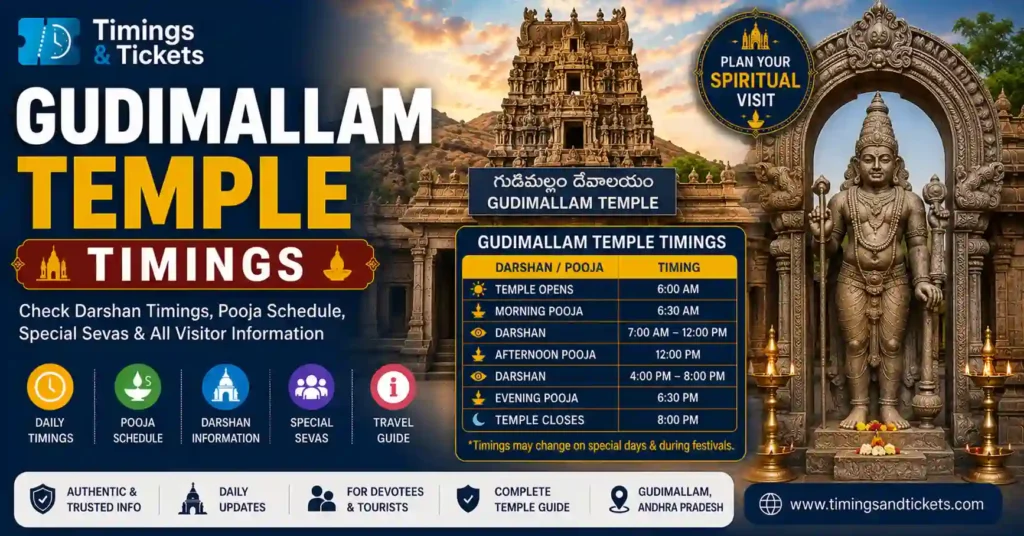
In most cases, people that search for Gudimallam Temple Timings plan to include the temple in their Tirupati Tour. It is about 13-17 km away from Tirupati, entry is free, and you can visit it in less than two hours, including time spent at the banks of Swarnamukhi river. That’s the practical part of the story.
Gudimallam Temple is much more than a mere pit-stop on your way back from Tirumala, though. The Shiva Lingam located within the temple is among the oldest sacred sculptures known to humankind, which dates back centuries ago before the time of Tirumala Temple. It is protected by the Archaeological Survey of India and is considered one of the most important archaeological findings in India by art historians. The guide includes all the necessary information about timings, Poojas, how to get there, and the whole story behind what you are seeing there.
Quick answer: Timings of Gudimallam temple are from 6:00 AM to 8:00 PM every day. Entry is free. Three main Poojas take place there every day along with Rudrabhisheka. Photographs cannot be made inside the temple.
Gudimallam Temple at a Glance
The essentials before the full schedule:
| Detail | Information |
|---|---|
| Temple | Sri Parasurameswara Swamy Temple (Gudimallam Temple) |
| Deity | Lord Shiva as Parasurameswara |
| What Makes It Unique | Houses one of the oldest known Shiva Lingas in the world (2nd/1st century BCE) |
| Location | Gudimallam village, Yerpedu Mandal, Tirupati district, Andhra Pradesh |
| Opens | 6:00 AM |
| Closes | 8:00 PM |
| Entry | Free |
| Photography | Not allowed inside |
| Protected By | Archaeological Survey of India (ASI) since 1954 |
| River | On the banks of the Swarnamukhi |
| From Tirupati | Around 13 to 17 km via Papanaidupet |
| From Renigunta Station | Around 16 to 17 km |
| Best Season | October to March |
Gudimallam Temple Timings 2026: Daily Schedule
The Gudimallam temple follows a day that never closes for a long period in the afternoon, which is an advantage over most other South Indian temples. The timing below will give a typical day. During festivals such as Maha Shivaratri and Karthika Masam, the timings increase and some extra sevas are done.

| Session | Timing | Notes |
|---|---|---|
| Temple Opens | 6:00 AM | First rituals of the day begin |
| Morning Darshan | 6:00 AM onwards | Suprabhata, daily Rudrabhisheka, morning archana |
| Midday Pooja | Around 12:00 PM | Noon ritual; brief reduced-access period |
| Afternoon Darshan | Continues after noon pooja | Afternoon darshan resumes |
| Evening Pooja | Around 5:30 PM | Evening aarti and deepa aradhana |
| Temple Closes | 8:00 PM | Gates close after night rituals |
Pradosha pooja conducted twice a month on the 13th lunar day is one of the most auspicious timings to visit Gudimallam. Devotees time their visits to coincide with Pradosha pooja to take part in this evening pooja offered to Lord Shiva.
Best Time To Visit: Early morning period between 6:00 am till about 9:00 am offers you quietest and least crowded darshan experience at the temple. If you are visiting in conjunction with Tirupati, early morning darshan of Gudimallam followed by Tirumala will work best.
Poojas and Sevas at Gudimallam Temple
Every day darshan at the temple focuses on Rudrabhisheka. Daily Rudrabhisheka at Gudimallam is a particularly powerful darshan owing to the old age of the lingam. There are no entry fees for darshan. Specific sevas need tickets.
| Seva / Ritual | Notes |
|---|---|
| General Darshan | Free; no booking required |
| Daily Rudrabhisheka | Performed daily; includes abhisheka of all Jyotirlingas |
| Abhishekam | Sacred bathing of the lingam with milk, honey, and sandalwood; ticket at counter |
| Archana (Ashtottara) | 108-name offering; nominal fee at counter |
| Sahasranama Archana | 1000-name archana; booked at counter |
| Rudrabhisheka (special) | On Maha Shivaratri and Karthika Masam; special timings apply |
| Pradosha Pooja | Performed on Pradosha days (twice monthly); one of the most auspicious times to visit |
Photography warning: Taking photographs or videos is strictly forbidden at the temple premises. There are strict guidelines laid out by ASI regarding conservation. It is the only rule that most devotees find themselves violating. Do not carry mobile phones into the temple.
The Gudimallam Lingam: What You Are Actually Looking At
There is no description of the temple’s interior that could equal its magnificence anywhere else. You should read this text before your visit.
Why This Lingam Is Unique in the World
The Gudimallam lingam is a monolith seven-sided sculpture that is about five feet tall above the floor level and carved out of polished sandstone of dark brown color. The stone continues under the floor level that was unearthed during the ASI excavations of the 1970s.
What makes it different from all other lingams in existence is the presence of a high-relief image of Shiva himself carved on it. In its entirety, it is an image of a hunter who holds a ram upside down in his right hand and a water pot in his left hand. The lower part of the lingam is covered by a figure of a dwarfish Yaksha, a creature from nature, who carries the weight of Shiva.
It is considered one of the oldest existing sculptures representing Shiva in his human form in the whole of India. Art historian J.C. Harle calls it the only sculpture of any importance that survives from ancient South India prior to the Gupta period. Such a statement gives you an idea of what is situated in this simple village temple.
Trinity in One Lingam
According to the legend of the temple, the lingam is an embodiment of the Hindu Trinity. Brahma represents the base of the lingam that is covered by the Yaksha. Vishnu is located in the middle through the personage of a hunter Parasurama who is an incarnation of Vishnu. Shiva is located in the upper part of the lingam. Thus, all three are combined in one sculpture.
How Old Is It?
Here lies another controversial point about the Gudimallam lingam, and it is important to understand the real truth in the matter. The date of creation of the lingam has been estimated differently from the 3rd century BCE to the 2nd century CE depending on the methodology applied. ASI excavations of 1973 revealed Black-and-Red Ware pottery, Satavahana era bricks sized 42x21x6 cm, a silver punch-marked coin, and remnants of brick apsidal temple built around the lingam. As a result, most scientists tend to believe that the Satavahana date (roughly 1st-2nd centuries CE) is more likely. On the other hand, there are art historians who consider it to be older and claim Mauryan age due to stylistic comparison with Sanchi railings.
What is not disputed, however, is the fact that the temple has been in continuous use for more than two thousand years. It makes the Gudimallam lingam several centuries older than the Tirumala temple whose earliest inscriptions have been dated roughly the 9th century CE.
First documented in 1903: The lingam was brought into wider scientific attention by the archaeologist T.A. Gopinath Rao in 1903. He measured the height of the visible part of the lingam as approximately five feet. Additional information about the temple has been kept in Chandragiri Fort Museum.
The River That Floods the Sanctum Every 60 Years
The Swarnamukhi river flows next to the Gudimallam temple. What is unknown to many people is the fact that the river floods the sanctum on a regular basis with an approximate 60 year cycle. The last time when the river water flooded the inner sanctum was 4 December 2005. Devotees perceive such floods as an auspicious event, a performance of abhishekam of the river over the ancient lingam.
The History: 2,000 Years of Continuous Worship
The Earliest Phase
Based on excavations by ASI done in 1973, the temple has been occupied since at least 2nd century B.C.E., where the early forms of worship were practiced in the open air near the lingam without construction of any building around it. Later, during the Satavahana period, the first brick apsidal temple was constructed using the large baked bricks whose dimensions correspond to the size used during the Satavahana era construction in other places.
The Medieval Dynasties
There is evidence of inscriptions found on the temple walls where several dynasties have made endowments of land, cows, and monetary gifts to the maintenance of daily worship over several centuries. The rulers of the Pallava dynasty, the Cholas and the Vijaynagara Kings contributed to the growth and renovations. The present architecture style is a result of their contribution with Chola and Pallava influence clearly seen in the temple’s sculptures. The temple was also controlled by the Chandragiri kings for some time.
The Muslim Period and ASI Protection
The temple was damaged in the medieval period during which part of the complex was destroyed. The lingam itself was safe being deeply placed in the sanctum. The ASI adopted this temple under its protection in 1954. Excavation that lowered the temple floor exposing the entire height of lingam and pedestal was performed in the 1970s. This provided stratigraphic data necessary for dating.
The Legend of Parasurama: The Origin of the Name of This Temple
One of the toughest stories in Hindu mythology belongs to Parasurama, the sixth incarnation of Vishnu. Jamadagni, his father, accused his mother Renuka of unchaste thought because she couldn’t concentrate during the ritual. The order to cut off her head was issued to his children. All refused but Parasurama followed his father’s order. Moved by his son’s compliance, Jamadagni offered him a boon and Parasurama requested that she comes back to life again.
However, the guilt of what he did couldn’t leave Parasurama alone. Other sages suggested him to perform penance in front of Lord Shiva to achieve redemption. Searching for days, he found this temple among the woods and started his penance with offerings of the flower appearing in a pond each day to Lord Shiva.
For protection of the flower Parasurama hired the Yaksha Chitrasena promising an animal hunted and a pot of toddy per day. Once he went hunting while Chitrasena could not restrain his desire to worship Shiva and took the flower for it. When Parasurama returned and found out about it, the fight started. Right after the victory of Parasurama Shiva appeared and granted the Sayujya Mukti to both Yaksha and Parasurama.
In this interpretation, Chitrasena was none other but Brahma disguised. Thus Vishnu in the form of Parasurama, Brahma in the form of Chitrasena and Shiva who is the lingam came together and are embodied in the one statue. And the name Parasurameswara, the Lord of Parasurama, remained.
Festivals at Gudimallam Temple
The festival calendar here is tied to the Shaiva tradition, and the crowd levels are a fraction of what you find at Tirupati, even on the busiest days.
- Maha Shivaratri: The biggest festival at Gudimallam, with all-night rituals, special abhishekam, and Rudrabhisheka. Extended hours through the night. The most-visited day of the year.
- Karthika Masam: The month of Karthika (October to November) is considered sacred for Shiva, with special poojas performed throughout the month and extended timings.
- Pradosha (twice monthly): On the 13th lunar day of each fortnight, Pradosha pooja draws regular pilgrims who plan their visits specifically around this timing.
- Ugadi: Telugu New Year, celebrated with special prayers.
- Navaratri and Arudra Darshan: Observed with additional rituals and larger crowds than on standard days.
Festival dates follow the Hindu lunar calendar and shift every year. Confirm the exact schedule before planning a visit during a festival period.
How to Reach Gudimallam Temple
Gudimallam is positioned almost exactly between Tirupati and Srikalahasti, making it a natural stop on a temple circuit.
From Tirupati (13 to 17 km)
Start from Tirupati through Tiruchanur Bypass to Srikalahasti. Turn right at Renigunta Junction towards Papanaidupet. Once you reach Papanaidupet, the temple can be reached along the same road. It is locally known as Sri Parasurameswara Swamy Temple, Gudimallam. The travel time is around 25 to 35 minutes. Local share autos ply from Papanaidupet to Gudimallam.
By Train (Renigunta Railway Station, 16 to 17 km)
The nearest railway station is the Renigunta Junction railway station. This station connects Tirupati, Chennai, and Hyderabad stations very well. You can get taxis from Renigunta to Papanaidupet and then continue your journey to the temple using local transports.
By Air (Tirupati Airport, 17 km)
Tirupati airport serves this area. You can hire a taxi from the airport and reach Gudimallam directly or through Papanaidupet.
Direct Buses
There are few buses from Tirupati to Gudimallam. In case of no availability of buses, it is best to catch a bus from Tirupati to Renigunta or Papanaidupet and then continue further to the temple in taxis or share jeeps.
Complementing Gudimallam Temple with the Tirupati Tourist Circuit
Gudimallam is the most unvisited temple of the Tirupati region as millions of Tirumala pilgrims pass by this temple within a few kilometres. Most people, after knowing this, regret not visiting this place before.
Day Tour Plan: Visit Gudimallam in the early morning from 6:00 AM to 9:00 AM which is the ideal time for darshan. This will take about 45 minutes to an hour of your time. Further, you can continue to visit Srikalahasti (another 30 km beyond Renigunta).
Dress Code and Visitor Guidelines
- Wear traditional, modest attire. Modern or revealing clothing is not permitted.
- Photography and videography are strictly banned inside the temple. This is an ASI rule and is enforced.
- Remove footwear before entering. Footwear stands are near the entrance.
- The temple is compact. Queues can build during festivals and on Pradosha days.
- No entry fee for darshan. For sevas, fees are paid at the temple counter.
- People with marriage delays and pregnancy wishes visit specifically for abhishekam here, a tradition tied to the lingam’s believed potency.
Frequently Asked Questions
1. What are the Gudimallam temple timings?
The temple is open from 6:00 AM to 8:00 PM daily. Three main poojas are performed: morning around 6:00 AM, midday around 12:00 PM, and evening around 5:30 PM. Timings extend on festival days.
2. Is there an entry fee at Gudimallam temple?
No. General darshan is free for all devotees. Specific sevas like abhishekam or archana carry a small charge, paid at the temple counter.
3. Is photography allowed at Gudimallam temple?
No. Photography and videography are strictly prohibited inside the temple, including near the sanctum. This is an ASI rule.
4. How far is Gudimallam from Tirupati?
Around 13 to 17 km via Papanaidupet. The drive takes about 25 to 35 minutes. The nearest railway station is Renigunta, about 16 to 17 km away.
5. Why is the Gudimallam Temple lingam famous?
It is one of the oldest surviving Shiva Lingas in the world, dated between the 3rd century BCE and 2nd century CE. It features a rare high-relief image of Shiva in human form, as a hunter standing on a Yaksha, considered one of the earliest depictions of Shiva in human form anywhere in India. The temple has been under continuous worship for over two thousand years.
6. Who is Gudimallam temple dedicated to?
Lord Shiva in the form of Parasurameswara, named after Parasurama (the sixth avatar of Vishnu), who is said to have performed penance at this site.
7. What is the best time to visit Gudimallam temple?
Early morning from 6:00 AM to 9:00 AM for the quietest experience. October to March is the most comfortable season. Pradosha days and Maha Shivaratri are the most auspicious times but draw larger crowds.
8. Which route does the Swarnamukhi river have to the temple?
The temple is built on the banks of the Swarnamukhi river. The river is known to flood the sanctum on roughly a 60-year cycle, with the last flood occurring in December 2005. Devotees consider this an auspicious natural abhishekam.
Conclusion
Gudimallam temple is open from 6:00 AM to 8:00 PM daily, entry is free, and photography is banned inside. It is about 13 to 17 km from Tirupati, worth combining with a Srikalahasti visit. The Shiva lingam inside is one of the oldest in the world, has been in continuous worship for over two thousand years, and stands as one of the most significant pieces of ancient Indian sculpture surviving anywhere. Most people who visit say they should have come decades earlier.
Also, Read: Nathdwara Temple Timing | Siruvapuri Murugan Temple | Kukke Subramanya Temple | Palani Temple Timings | Jogulamba Temple Timings